Neither Tires nor Rubber Shoes: Debunking False Beliefs About Lightning Protection
The majesty and power of a thunderstorm have generated, throughout history, countless myths and popular beliefs. Many of these ideas, passed down from generation to generation, lack a scientific basis and can lead to a false sense of security. At Aiditec Systems, as experts in safety and protection against atmospheric phenomena, we consider it essential to debunk these falsehoods and explain the real principles that govern lightning protection.
Myth 1: A car's rubber tires protect you because they insulate you from the ground.
This is, perhaps, the most widespread misconception. The protection offered by a closed vehicle does not come from its tires. The amount of rubber in a tire is completely insufficient to insulate from a lightning strike, which can reach hundreds of millions of volts. The real reason a car is a relatively safe place during a storm is the principle of the Faraday Cage. The metal body of the vehicle conducts the electrical current around the outside and safely discharges it to the ground, protecting the occupants inside. Therefore, a convertible, even with rubber tires, offers no protection.
Myth 2: Rubber-soled shoes protect you if you are outdoors.
As with tires, the thin layer of rubber on a shoe's sole is absolutely ineffective as an insulator against the power of a lightning strike. If lightning strikes a person directly or nearby, the current will find a path to the ground, and footwear will not pose any significant obstacle. Furthermore, the danger lies not only in a direct strike but also in ground currents (step potential), which can be lethal several tens of meters from the point of impact. The only safe measure outdoors is to seek proper shelter immediately.
Other Misconceptions and the Scientific Reality
"Lightning never strikes the same place twice." This statement is completely false. In fact, lightning tends to repeatedly strike tall, conductive points. Structures like the Empire State Building in New York or telecommunications towers are struck dozens of times a year. Lightning always seeks the path of least resistance to the ground, and these high points consistently provide it.
"If it's not raining, there's no danger of lightning." Another dangerous mistake. Lightning can strike miles away from the core of the storm, in areas where the sky may even be clear. These are known as "dry lightning" or "bolts from the blue." The safety rule is clear: if you can hear thunder, you are close enough to be struck by lightning and should seek shelter.
True Protection: Engineering and Prevention
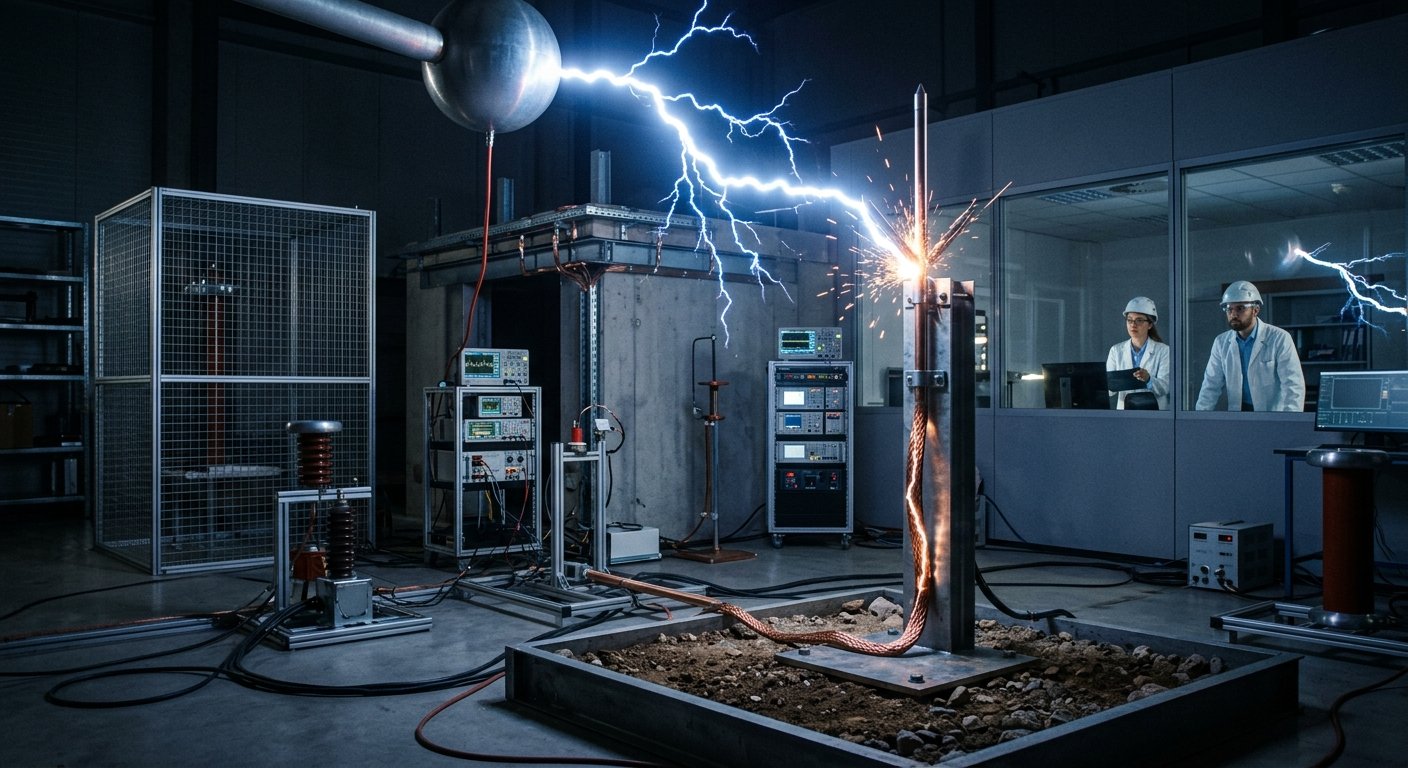
Effective lightning protection is not based on myths or everyday materials like rubber. It is based on engineering and the application of physical principles through systems specifically designed for this purpose. A comprehensive lightning protection system (LPS) consists of air termination systems (lightning rods), down conductors, and a grounding system. This assembly creates a safe and controlled path for the lightning discharge to dissipate into the earth without causing damage to the structure, electronic equipment, or, most importantly, people.
At Aiditec Systems, we base our work on science and engineering, not on myths. We offer comprehensive lightning protection solutions, from risk assessment to the installation and maintenance of systems that guarantee the safety and operational continuity of your facilities. Do not leave your safety to chance or popular beliefs. Trust in expert protection.